When I look at the future of digital marketing, one thing is becoming increasingly clear: Artificial Intelligence (AI) is changing how marketers research, create, analyse, and connect with audiences. I no longer see AI as simply another technology that marketers can choose to explore. Instead, I see it as an important skill for anyone who wants to remain effective in a rapidly changing digital environment.
Recent marketing research shows that AI fluency is becoming a major skill for marketers, while strategic thinking, adaptability, creativity, and critical thinking remain highly valuable human capabilities. This tells me that future marketers will need to combine AI capabilities with strong marketing fundamentals rather than depend entirely on automation.
How Is AI Changing Digital Marketing?
In my experience, AI can make many marketing activities faster and more organised. Marketers can use AI to identify content ideas, analyse customer behaviour, study search intent, develop campaign concepts, generate initial content drafts, and examine marketing data.
However, I believe the real value of AI comes from knowing how to use it intelligently. Simply generating content with an AI tool does not make someone a better marketer. I still need to understand the audience, brand voice, customer journey, marketing objectives, and desired business outcomes.
Why Should Future Digital Marketers Learn AI?
AI Can Improve Marketing Productivity
One of the biggest advantages I see is productivity. AI can help reduce the time required for repetitive tasks such as brainstorming, summarising research, organising information, and analysing large amounts of data.
This gives me more time to concentrate on strategy, creativity, customer experience, and decision-making. Instead of spending hours completing routine work, I can use AI to support the early stages and then apply human judgement to improve the final result.
AI Is Transforming Search and Content
Search behaviour is also changing. Users increasingly interact with AI-powered search experiences that provide direct, conversational answers. AEO and GEO are therefore receiving greater attention alongside traditional SEO.
For me, this means learning how to create content that is useful to people and easy for search and AI systems to understand. Clear answers, relevant information, logical headings, strong topical coverage, and trustworthy content can all contribute to better visibility across evolving search experiences.
As I continue to Master Digital Marketing, I need to understand not only traditional search optimisation but also how AI is influencing information discovery.
AI Supports Better Data Analysis
Digital marketing produces enormous amounts of data. Website traffic, conversion rates, engagement, advertising performance, search behaviour, and customer interactions can all provide valuable insights.
AI can help marketers identify patterns and organise information more efficiently. However, I still need to interpret those insights within the context of the business.
For example, an increase in website traffic does not automatically mean a campaign succeeded. I need to consider whether the traffic came from the right audience, whether visitors engaged with the website, and whether the campaign contributed to meaningful conversions.
AI Encourages Continuous Learning
The digital marketing industry changes quickly, and AI is accelerating that change. New tools, workflows, search experiences, and marketing applications continue to emerge.
That is why I believe future marketers need a learning mindset. Rather than trying to master every new tool, I focus on understanding the principles behind AI-assisted marketing and learning how different technologies can support specific objectives.
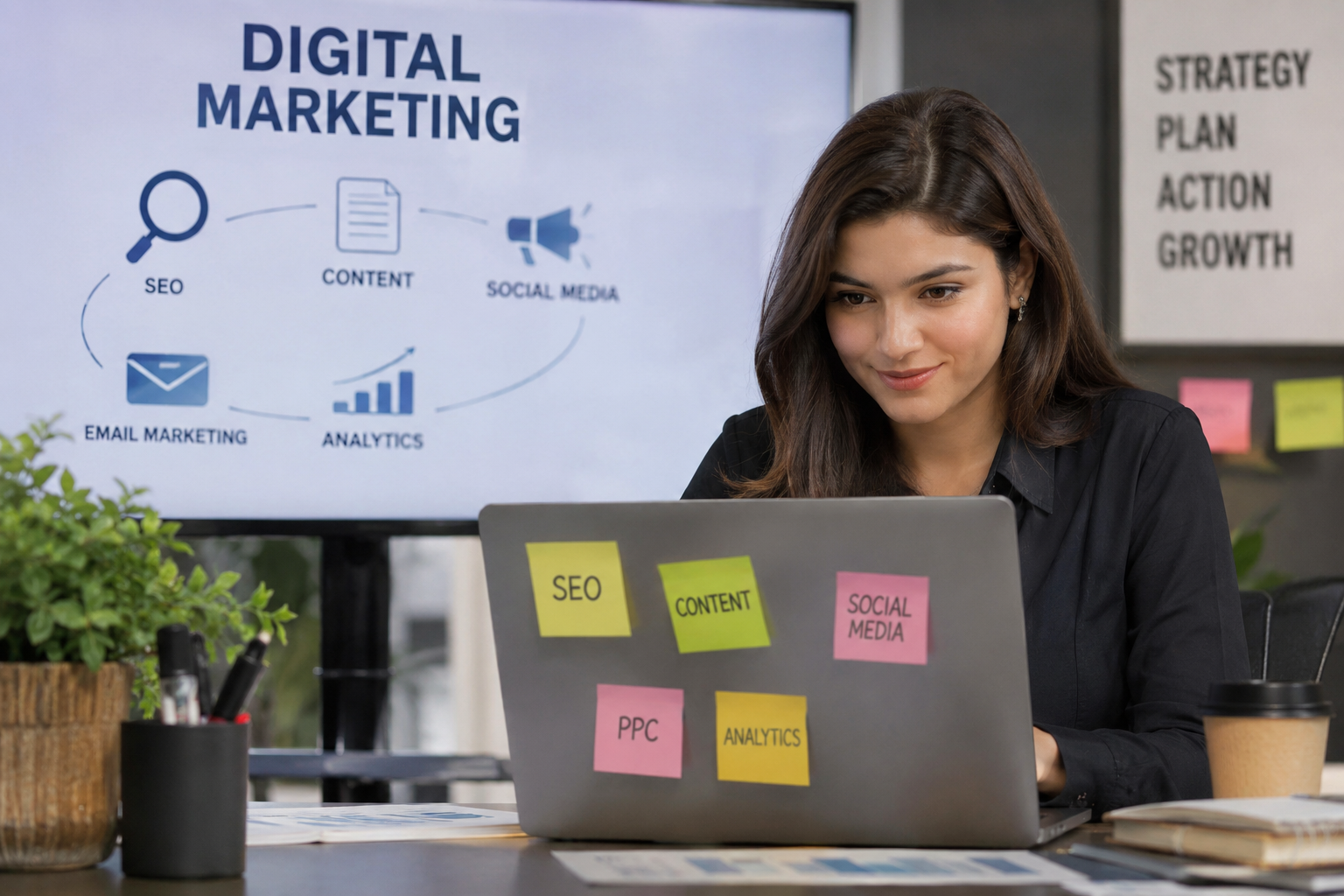
Professionals who want to Master Digital Marketing can benefit from combining core skills such as SEO, content marketing, social media, paid advertising, analytics, and strategy with practical AI knowledge.
How Can I Prepare for an AI-Driven Marketing Career?
I can start by learning how AI works at a practical level and experimenting with relevant tools. I can then apply AI to real marketing tasks such as keyword research, content planning, customer research, campaign analysis, and workflow automation.
I also need to develop skills that technology cannot easily replace, including critical thinking, creativity, communication, strategic planning, adaptability, and ethical decision-making. The 2026 American Marketing Association research similarly highlights AI fluency alongside these human-centred capabilities.
For learners looking for structured guidance, exploring practical digital marketing learning and AI-focused training can provide a useful foundation.
What I Believe the Future Holds
I do not think AI will simply eliminate the role of digital marketers. Instead, I expect the responsibilities of marketers to evolve. Routine execution may become increasingly automated, while strategic thinking, originality, brand understanding, and human judgement become more important.
For me, learning AI is therefore about becoming a more capable marketer—not about replacing the skills I already have.
The future belongs to marketers who can combine technology with creativity, data with judgement, and automation with genuine customer understanding. By developing these abilities today, I can become better prepared to Master Digital Marketing and adapt to whatever comes next.
Frequently Asked Questions
Why is AI important for future digital marketers?
AI can help marketers improve productivity, analyse data, personalise customer experiences, support content development, and adapt to changing search behaviour.
Will AI replace digital marketing professionals?
AI can automate or assist with many marketing tasks, but human skills such as strategy, creativity, critical thinking, communication, and decision-making remain important. Current marketing research describes marketing roles as shifting rather than simply disappearing.
Should beginners learn AI before digital marketing?
I recommend learning both together. Understanding marketing fundamentals first helps beginners use AI more effectively instead of relying on AI-generated outputs without strategic context.
How does AI affect SEO, AEO, and GEO?
AI is changing how people discover information and how content can appear in answer-driven and generative search experiences. AEO and GEO complement traditional SEO rather than making fundamental search optimisation irrelevant.
Start Building Your Future Digital Marketing Skills
Learning AI today can help me become more adaptable, productive, and prepared for the changing demands of digital marketing. If you want to develop practical knowledge and Master Digital Marketing with modern skills, explore practical digital marketing learning and career-focused training.
Ready to take the next step? Contact the digital marketing training team to learn more about available learning opportunities.